
To mark his 50th death anniversary, rediff.com has launched a special series to evaluate Jawaharlal Nehru's legacy.

If you don't have power in a game you are masters of, the world will walk all over you, notes Shekhar Gupta.

'We eat first, they later; we sit on chairs and they on the floor; we call them by their names and they address us by titles,' writes Tripti Lahiri, author of Maid in India.

How to deal with a country that has made export of terror a reason to make the world notice and fund it? Rediff.com contributor Sanjeev Nayyar offers a few suggestions

Mr Modi can create a small temporary team in the PMO whose only job would be to listen to businessmen's mann ki baat referring to global best practices.

'IAF is expanding at a rapid pace'

We have failed to acknowledge the volatile events that have changed Mumbai.

More Indians are watching films across screens, TV, online and other platforms than ever before. Whether it is by tackling costs, processes or revenues, the trick is to find a way of making money from all of them, says Vanita Kohli-Khandekar.

The Indian Spring represented by Anna Hazare's anti-corruption campaign, which has culminated in the Aam Aadmi Party's impressive electoral debut in New Delhi, began around the same time as the Arab Spring in 2011 but they led to different outcomes in India and the Arab world, says Ramesh Ramachandran.
The current draft of the Goods and Services Tax could kill any hope of economic revival - and you should blame the Congress if it rolls over and lets it pass, says Mihir S Sharma.

'The most valuable personal sensitive information of present and future citizens has been made available to foreign data firms and governments and non-State actors for all time to come,' says Gopal Krishna.

Here's everything you need to know about the Goods and Services Tax Bill.

More lucrative routinely prescribed drugs are at higher risk of failing quality standards

'The lesson the BJP has to learn from the violence in Gujarat is that once you practise the politics of hate against any community, it will surely get back to you some day.'

'How can middlemen disappear as long as our political parties are sucking in massive amounts of black money?' 'There is an old political art well practised in New Delhi -- people create artificial problems and then solve it for you to earn your gratitude for a lifetime.'

'Castro's huge appeal lies in the fact that he stood up to the Americans.' 'However, it becomes difficult to be judgmental about his legacy, because there are huge uncertainties about the future of the Cuba that he built,' says Ambassador M K Bhadrakumar.

The plan of UID/Aadhaar-based surveillance does not end with the collection of fingerprints and iris scan, it goes quite beyond it and poses a lethal threat to the idea of India, says Gopal Krishna.

Yale University has issued a statement saying that Human Resource Development Minister Smriti Irani attended a weeklong programme and received a certificate from the university last year, along with several other lawmakers from India. George Joseph/Rediff.com reports from New York
An ill-informed public narrative centres on expensive weapons platforms instead of the little things that would improve capability.

The question is whether the Indian economy has the advantage of other vibrant sectors that can step up their performance on the exports front, says A K Bhattacharya.
We need credible retellings of the times we have lived through, or the events in the immediate past that have shaped our today, says Mihir S Sharma

'The best remedy would be to scrap Section 124-A of the IPC, a colonial vestige, altogether.' 'However, if legislators don't want to do so, they can do two things.' 'They can formally amend Section 124-A to bring it in line with what the Supreme Court has said about sedition.' 'The words which stand on the statute book today were inserted in 1898.' 'The Supreme Court's words are not a part of Section 124-A.'

'there is absolutely no question that the Hinduism of the mob-lynchers, the people who have actually gone and killed others because of what they are eating or how they are worshipping or the faith they belong to or what they're doing professionally, those are, to my mind, not Hindus at all.' 'Hinduism needs to be reclaimed for the Hindus who are not bigots.'

Mudra Bank will be a Rs 20,000-crore institution, which would "primarily be responsible for refinancing all micro-finance institutions.

'Drought in the 1990s was essentially the drought of a poor India.' 'This 2016 drought is of a richer and more water-guzzling India.' 'The severity and intensity of the drought is not about lack of rainfall.' 'It is about the lack of planning and foresight, and criminal neglect.'

Public sector banks are inefficient, poorly governed and beset by largescale corruption.

In his latest book, Fly Me To The Moon, former member of Parliament Prafull Goradia provides interesting insights into the man who is India's prime minister.

'Pakistan needs to be constantly at war with somebody, ultimately resulting in it waging war on itself and its own people,' says Shekhar Gupta.

The Mercedes-Benz SLK 55 AMG's biggest strength is that despite its uber luxe branding, it can be a car for your daily drive

With over 135 news channels, about a third owned by politicians and real estate guys, the news TV market is a nightmare, says Vanita Kohli-Khandekar.

'It is extremely important to take back the domain of both religion from the religious bigots and nationalism from the chauvinists, who are spreading hatred.' Sugata Bose, the Harvard historian-turned-MP, who is Netaji's great-nephew, tells Anjali Puri why it is imperative to speak up for India's students.

India needs to build its Grand Narrative, and its cultural power, which conquered all of ASEAN (then known as Indo-China), needs to be forcefully projected while simultaneously hard economic and military power are also emphasised, says Rajeev Srinivasan.
'India should stop claiming that a united Pakistan is in India's interests.' 'Pakistan's break-up is a necessity for peace and progress in the region,' says Major General Mrinal Suman (retd).
On the eve of the release of his book, 2014: The election That Changed India, Rajdeep speaks candidly in an interview with Sheela Bhatt/Rediff.com.

'The original dream of people like Faiz was that Pakistan would be something different from the old India: Progressive, forward looking, democratic (if not socialist), tolerant, diverse and pluralistic.' 'I don't think anyone foresaw the catastrophe that Partition was to become.'

'It is certainly time for New Delhi to open up. Not only should it go ahead at full steam with the roads to the LAC, but the government must also allow tourists to visit these stunningly beautiful areas of Indian territory.'

'Masaan went to Cannes, got a standing ovation, won awards. I want the people of India to watch my film. Finally, it is happening!'
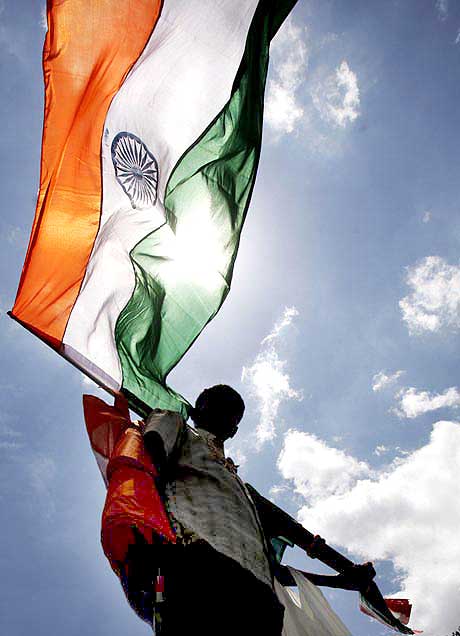
How has the Indian State, in principle and practice, given shape to the essential ingredients of the secular principle and composite culture?

Why are more and more international models taking centre stage in the Indian fashion industry? Abhishek Mande Bhot/Rediff.com finds out.
There is a churning going on among Muslims, and Mehmood Madni should be credited for breaking the silence. He has initiated a debate on the options before Muslims to look beyond the Congress yoke and fear of the BJP, says Ehtasham Khan
